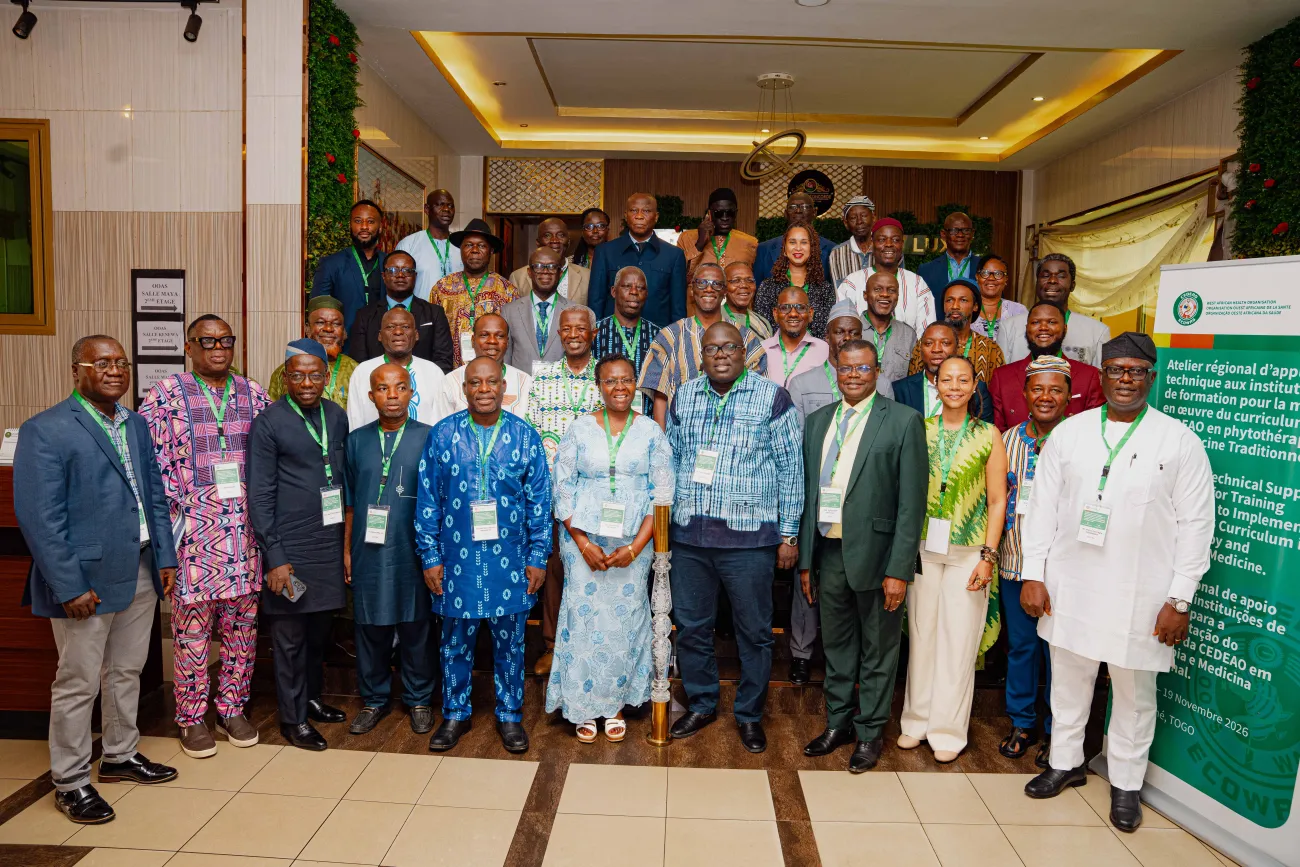
The West African Health Organisation (WAHO), the specialised Institution of the Economic Community of West African States (ECOWAS) responsible for health issues, opened a regional workshop in Lome, Togo, on 17 November 2026 to help training institutions introduce the harmonised ECOWAS curricula in herbal and traditional medicine.
The three-day workshop runs until 19 November and brings together representatives of health ministries and training institutions, researchers, experts and traditional medicine practitioners.
Traditional medicine is often the first source of care for people in West Africa, particularly in communities with limited access to conventional health services. Yet opportunities for structured training remain limited, and certification requirements vary across countries. Participants are sharing experience on how to adapt the regional curricula to national needs, certify practitioners and assess the quality of training.
Opening the workshop on behalf of Togo’s Ministry of Health, Public Hygiene, Universal Health Coverage and Insurance, Dr Abdoukarim NABA MOUCHEDOU, Head of the Community Health and Older Persons Division and WAHO’s National Focal Point in Togo, welcomed the initiative. He reaffirmed Togo’s commitment to strengthening regulation, research, training and professional oversight so that traditional medicine can better complement conventional care.
Speaking on behalf of the Chair of the ECOWAS Authority of Heads of State and Government, Professor Emmanuel BASSENI, Director of Senegal’s Pharmacology and Traditional Medicine Programme, drew on Senegal’s experience to inform discussions on professional standards and a common approach to training across the region.
Dr Virgil K. LOGOSSOU, WAHO’s Director of Healthcare, spoke on behalf of the Director General, Professor Palokinam T. PITCHE. He stressed that integrating traditional medicine into health systems requires qualified practitioners who receive regular supervision. Referring to the Regional Guidelines on Traditional Medicine adopted in 2026, he called on each Member State to develop a roadmap for introducing the regional curricula in at least one national training institution.
Professor Agnon Ayeola Koffi BALOGOU, President of the Regional Council for the Training of Health Professionals, emphasised that training must draw on traditional knowledge, meet scientific standards and prioritise patient safety. He highlighted the regional professional bachelor’s degree in traditional medicine, which focuses on herbal medicine and comprises 42 modules worth 180 credits over six semesters.
Participants are expected to adopt recommendations and a regional roadmap for introducing the curricula. They are also due to define a monitoring and evaluation framework and establish a regional technical committee to lay the groundwork for a West African Academic Consortium for Traditional Medicine.


