
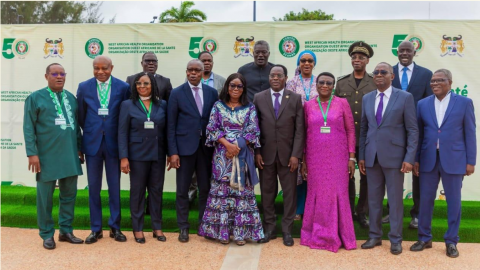
The West African Health Organisation (WAHO) launched, this Monday 24 March 2026, at the Sofitel Hotel in Cotonou, the Regional Community Health Policy of the Economic Community of West African States (ECOWAS), a strategic initiative aimed at positioning community health as a central pillar of universal health coverage and strengthening health systems across the region.
The ceremony brought together government representatives, technical and financial partners, as well as delegations from Member States, reflecting a shared commitment to bringing health services closer to communities and strengthening prevention strategies. The launch of the policy was presented as a strategic milestone reflecting the region’s ambition to place communities at the centre of health policies. Representing His Excellency the President of the ECOWAS Commission, Oumar Alieu Touray,
the Director-General of WAHO, Dr Melchior Athanase Joël Codjovi Aïssi, officially launched the ECOWAS Regional Community Health Policy, describing it as a turning point in addressing persistent weaknesses in health systems across the region. Dr. Melchior Aïssi further stressed that this policy represents a paradigm shift, moving from facility-centred health systems to people-centred systems, as well as from sectoral to
multisectoral approaches, and called for its swift and effective implementation.
The Minister of Health of Benin, Professor Benjamin Hounkpatin, was represented by his Chief of Staff, Dr Sibylle Assavoedo. stated that health begins within communities and described community health as a key strategic lever for building resilient and equitable health systems. She also highlighted the progress made by Benin, particularly through citizen participation mechanisms centred at household level, positioning the country as a regional model in implementing innovative community health approaches.
Despite these advances, she pointed to persistent challenges, including climate change, zoonotic diseases, and the need to strengthen political commitment, professionalise the workforce, improve health information systems, promote multisectoral action, and ensure sustainable financing.
In his welcome address, His Excellency Ambassador Amadou Diongue, ECOWAS Resident Representative in Benin, emphasised that West African countries face similar health challenges, requiring coordinated responses supported by strong political commitment. He further noted that community health is fundamental to human capital development and essential to ensuring equitable access to healthcare. Recalling lessons learned from the COVID-19 pandemic, he stressed the importance of placing communities at the centre of action to build resilient health systems.
The UNICEF Representative in Benin, Ousmane Niang, speaking on behalf of technical and financial partners, highlighted the significant investments made to extend healthcare services to the most remote populations. He underlined that community health is one of the most cost-effective approaches to reaching all population groups and paid tribute to the work of community health workers.
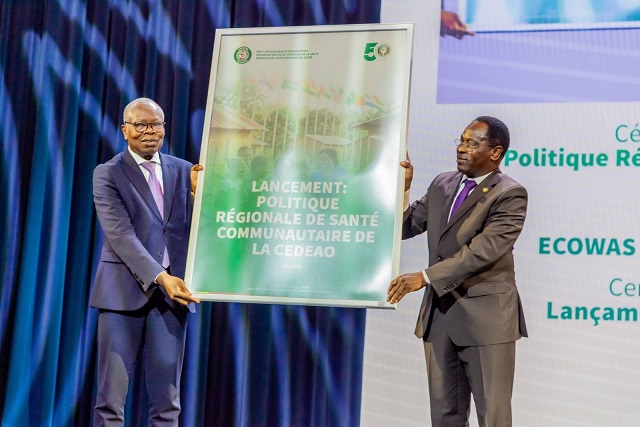
One of the key moments of the ceremony was the official presentation of the new policy by Dr. Arístide Talon, Special Adviser to the President of the Republic of Benin on Health, followed by the handover of a copy of the policy and other strategic documents such as the Consensus Standards and Principles and the Regional Guidance Framework for its operationalisation to Member States.
MS Magdalene Harding, WAHO Liaison Officer for Sierra Leone, delivered the vote of thanks on behalf of Sierra Leone, the country currently charring ECOWAS. She highlighted the historic nature of the moment, noting that it marks not only the launch of a policy but the beginning of a movement placing communities at the Centre of healthcare delivery. She commended the leadership of WAHO and the commitment of Ministers of Health, calling on Member States to integrate the policy into their national systems and translate it into concrete action.